
Study support
Table of Contents
Study advocacy
The education policy sector (koulutuspolitiikka or kopo in Finnish) of LTKY oversees the interests of the student union members in study matters and national higher education policy matters. The LTKY kopo sector consists of the student union board’s educational policy representative(s) and an education policy specialist, who is a staff member. Their areas of responsibility include, among others, the exam archive, the annual teaching quality survey, problems related to courses, and the development of education together with LUT. The kopo sector works closely with guild boards and student representatives in the administration.
The education policy sector actively maintains contact with various parties both locally and nationally. Locally, the kopo sector often meets with, among others, the university’s study services, the vice-rector responsible for education, and the education development managers. In addition, the kopo sector participates in several different LUT working groups and committees. Nationally, the LTKY maintains contact with many national influencers and other student unions. Close cooperation is also carried out with, for example, National Union of University Students in Finland (SYL), peripheral student unions and Tekniikan Akateemiset (TEK).
Contact information for the education policy sector can be found on the Organization tab. The sector can also be reached at [email protected].
Study guidance
If you feel that your studies are not progressing as you would like, contact your study advisor or study counsellor in your field of study. You can discuss with them how you can move forward in your studies. The study advisor provides advice on personal study plans, helps with crediting studies and processes requests for additional time. The study advisor helps with registration and questions related to courses, among other things. Study advisors and thesis supervisors provide support in bachelor’s and master’s theses.
More information about the study guidance team can be found in eLut.
Study Psychologist
“We will help you succeed in your studies, feel good and have energy for other things too!”
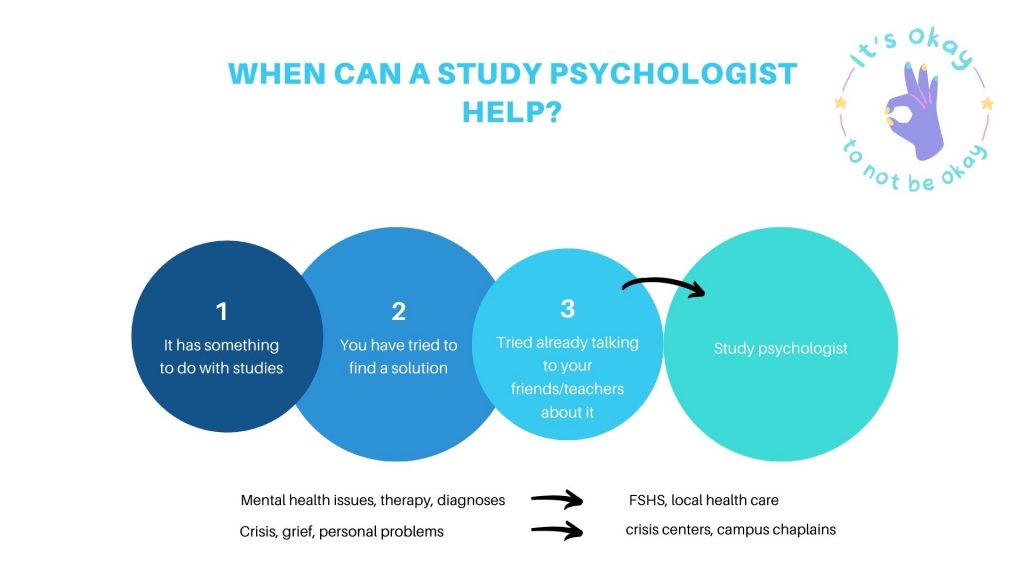
There are study psychologists in LUT to give support and counseling for students on study-related issues. Study psychologist offers individual sessions, lectures and webinars.
Students can book a session with study psychologists to discuss topics such as:
- Finding motivation
- Thesis-related anxiety
- Coping with workload
- Difficulties with distance learning
- Coping with stress
- Stage fright
- Hard to focus
Contact information and other information is also available in eLut.
Learning difficulties
Some students have learning difficulties that can make it difficult to take things up, write assignments, take exams, work in groups, or follow instructions given by a teacher.
If you have a documented diagnosis of learning disability, it can be taken into account in different study-related situations, depending on your needs and possibilities. If, on the other hand, you have not yet been diagnosed with a learning disability, but you think you might have one, you can contact FSHS about this.
The student must be in contact with the student services tenttivalvonta(at)lut.fi at least 1,5 week before the exam in order to take the exams with special arrangements. In the email please provide your contact information, course name and code and documented expert opinion.Special arrangements for the course are agreed directly with the teacher in charge of the course.
More information about study accessibility and individual services can be found in eLut.
Instructions for taking the exam
- If possible, the student may, for justified reasons, take the exam in a separate room and be given additional time to complete the exam.
- If possible, the student may, for justified reasons, write the exam on a computer at the exam session.
- The student may be offered alternative ways of taking the exam, such as oral examinations. This must be agreed with the teacher in charge of the course.
- Students have the right to receive feedback on their exam orally. This must be agreed with the teacher in charge of the course.
Guidelines for evaluation
- When assessing a student’s performance, point credits are not granted due to reading difficulties, but the student’s performance is supported in other ways mentioned in the university’s common guidelines.
- In the assessment of performance, the main focus is on assessing the quality of the information and not on assessing the appearance of the language.
- Language courses also give a grade for content, if possible.
- Any assessment should also take into account the different possibilities for compensation.
SOURCE: Teacher’s Quality Guide
Who to contact if you have learning difficulties?
- If you suspect you have a learning disability
- Study supervisor or FSHS
- If you know you have a learning disability
- Accessibility contact if you need help informing the training program (e.g. you don’t want to talk to the teacher directly)
- Teacher when you want to discuss directly the completion of the course with special arrangements
- Student services when you need special arrangements for the exam
You can also always contact the Head of Student Services at LUT